
Welcome to the deep north of Japan! Aomori Prefecture, located at the northernmost tip of Japan’s main island (Honshu), is a region deeply rooted in ancient spirituality, breathtaking natural landscapes, and some of the most mysterious and profound folklore in the country. While most tourists flock to Tokyo or Kyoto, those who venture into Aomori are rewarded with a journey that touches the soul.
Today, we will explore three of the most extraordinary and spiritually significant sites in Aomori: The Kabushima Shrine, where tens of thousands of seagulls guard a goddess of wealth; Mount Osore, one of Japan’s three most sacred mountains that serves as the gateway to the afterlife; and the baffling “Tomb of Christ,” a legendary site wrapped in incredible myth. Let’s embark on this deep spiritual journey!
1. General Access Guide: Reaching Aomori
Aomori may feel like a different world, but it is surprisingly accessible from Tokyo.
From Tokyo Station (By Train)
The easiest and most scenic way to reach Aomori is by taking the Tohoku Shinkansen (Bullet Train). Board the “Hayabusa” train from Tokyo Station. In just about 2 hours and 45 minutes, you will arrive at Hachinohe Station. This will be your primary hub for exploring the coastal and eastern regions. The Japan Rail (JR) Pass fully covers this route!
From Haneda Airport (By Air)
If you prefer flying, domestic flights operated by JAL and ANA offer quick access. A flight from Haneda Airport to Misawa Airport (near Hachinohe) takes only about 1 hour and 20 minutes.
2. Kabushima Shrine: The Island of Tens of Thousands of Seagulls
The Historical and Religious Background
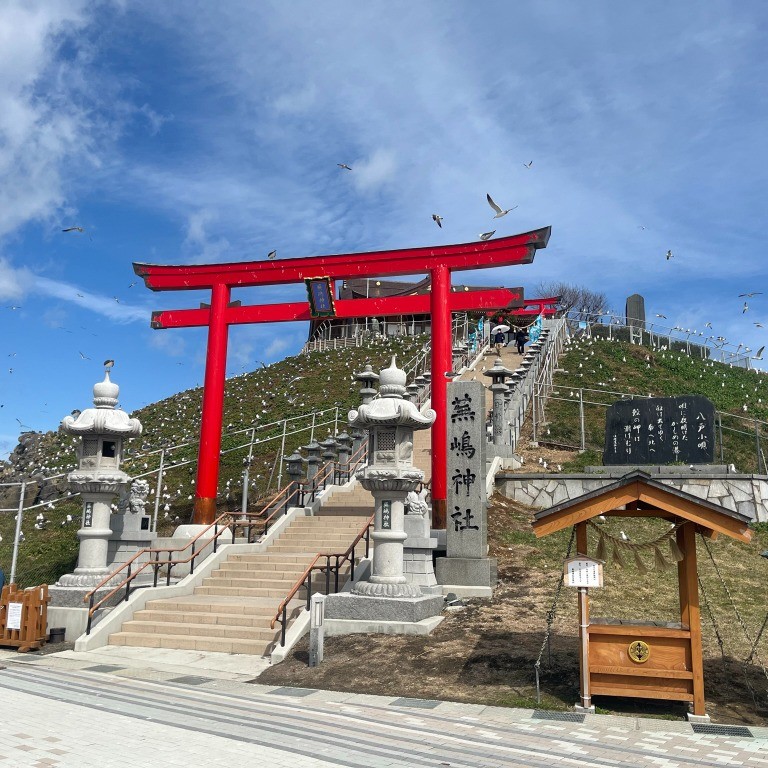
Kabushima Shrine (蕪嶋神社) is located in the coastal city of Hachinohe. Although it is called an “island” (shima), it is currently connected to the mainland. The shrine was originally established in the 13th century and is dedicated to Benzaiten, the Buddhist and Shinto goddess of wealth, music, eloquence, and water. Fishermen have worshipped here for centuries, praying for safe voyages and bountiful catches.
In 2015, the main shrine building tragically burned down in an electrical fire. However, the local community rallied together with overwhelming support, and the shrine was miraculously and beautifully rebuilt and reopened to the public in 2020. The stunning red torii gates leading up the hill against the backdrop of the deep blue Pacific Ocean is a sight to behold.
The Phenomenon of the Black-tailed Gulls
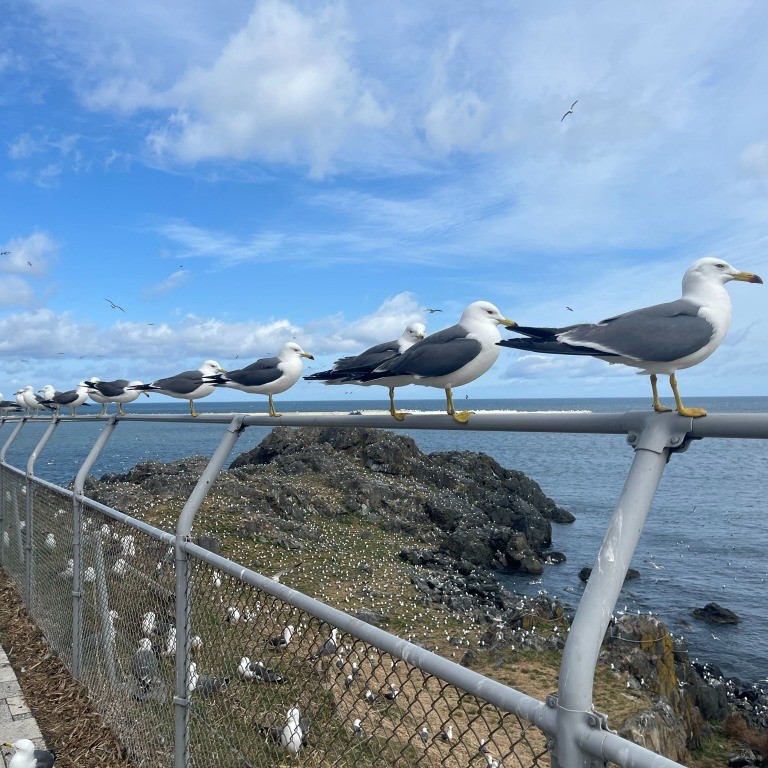
What truly makes Kabushima unique in the world is its designation as a national natural monument due to the breeding grounds of the Black-tailed Gulls (Umineko). Every year from early March to August, an astonishing 30,000 to 40,000 seagulls flock to this tiny hill to lay their eggs and raise their chicks.
In Japanese culture, the gulls are considered the divine messengers of Benzaiten. Here, an amusing cultural pun exists: if a seagull drops its droppings (a “bomb”) on you, it is actually considered incredibly good luck! The Japanese word for droppings is “un” (運), which sounds exactly like the word for “luck” or “fortune.”
📍 Specific Access Guide to Kabushima Shrine
By Train & Foot: From Hachinohe Station, transfer to the JR Hachinohe Line and ride for about 20 minutes to Same Station (鮫駅). From Same Station, it is a pleasant 15-minute walk along the scenic coast to the shrine. Total travel time from Hachinohe Station is under 40 minutes.
3. Mount Osore (Osorezan): The Gateway to the Afterlife
One of Japan’s Three Most Sacred Places
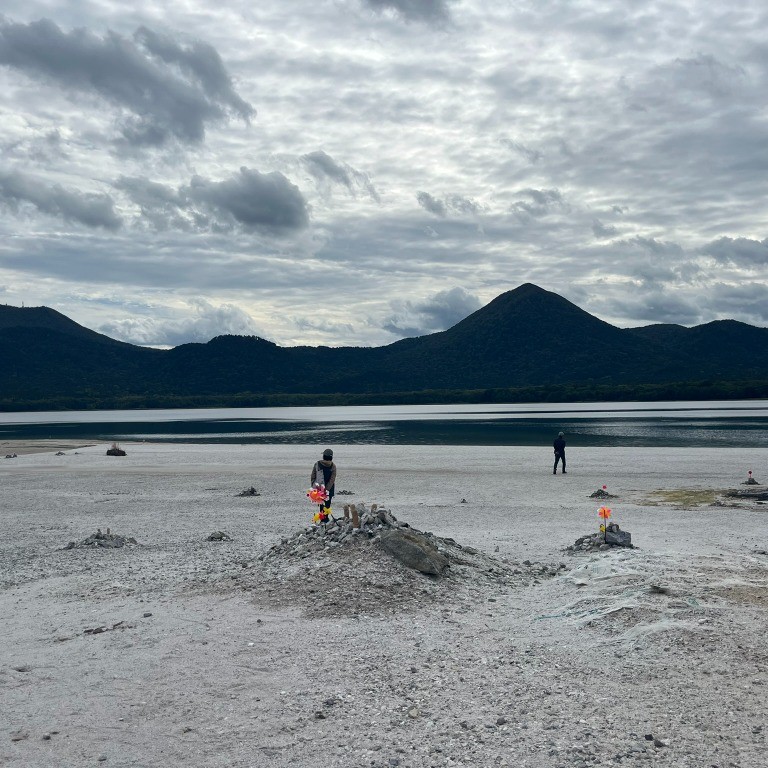
Moving further north to the axe-shaped Shimokita Peninsula, we arrive at Mount Osore (恐山, literally “Fear Mountain”). Alongside Mount Koya and Mount Hiei, Mount Osore is revered as one of the three most sacred sites in Japan. It was discovered over 1,000 years ago by the Buddhist monk Jikaku Daishi (Ennin) while he was searching for a sacred mountain that resembled the world of the Buddha.
Mount Osore is considered the boundary between the world of the living and the world of the dead. The landscape is profoundly dramatic. The area surrounding the Bodai-ji Temple is an active volcanic caldera. Steam vents hiss from the cracked, rocky ground, and the strong smell of sulfur fills the air. This barren, desolate area is fittingly called “Hell” (Jigoku).
Pinwheels, Jizo, and the Shamans
In stark contrast to the hellish rocks lies Lake Usori, a highly acidic caldera lake with stunningly clear, emerald-green waters and white sandy beaches. This tranquil area is known as “Paradise” (Gokuraku).
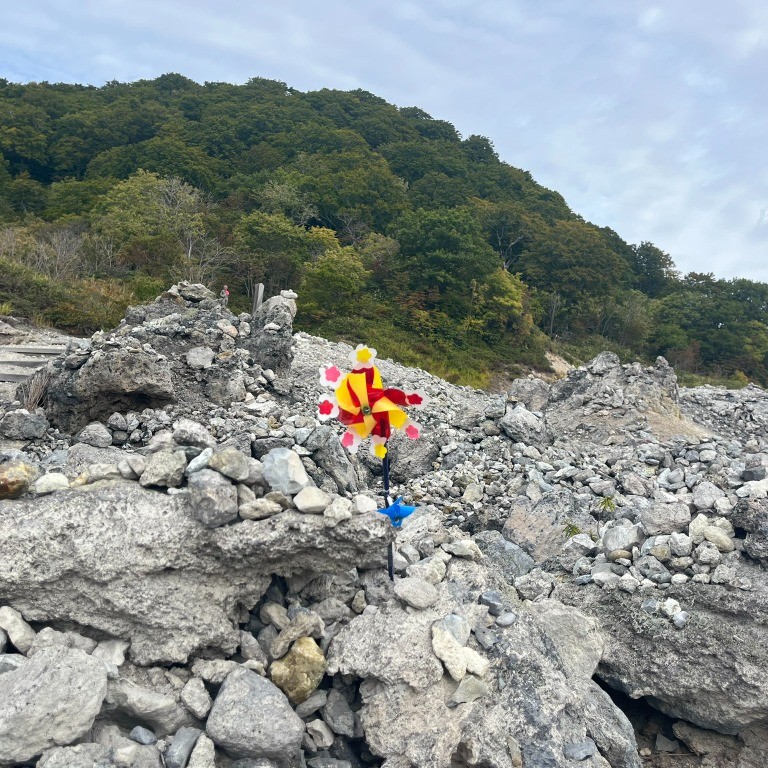
As you walk the grounds, you will notice countless colorful pinwheels (kazaguruma) spinning in the wind. These are placed by grieving parents to comfort the souls of children who died young. Mount Osore is also famous for the Itako—blind female shamans who undergo rigorous spiritual training. During the mountain’s grand festivals, the Itako perform a ritual to summon the spirits of the dead and deliver messages to mourning relatives.
📍 Specific Access Guide to Mount Osore
By Train & Bus: Getting to Mount Osore is a deep journey. From Hachinohe Station, take the Aoimori Railway to Noheji Station, then transfer to the JR Ominato Line to Shimokita Station (下北駅) (approx. 2 hours total). From Shimokita Station, board the Shimokita Kotsu Bus bound for Osorezan. The bus ride takes about 45 minutes, winding through deep forests until the caldera suddenly opens up before you.
4. The Tomb of Christ (Kirisuto no Haka): A Bizarre Historical Legend
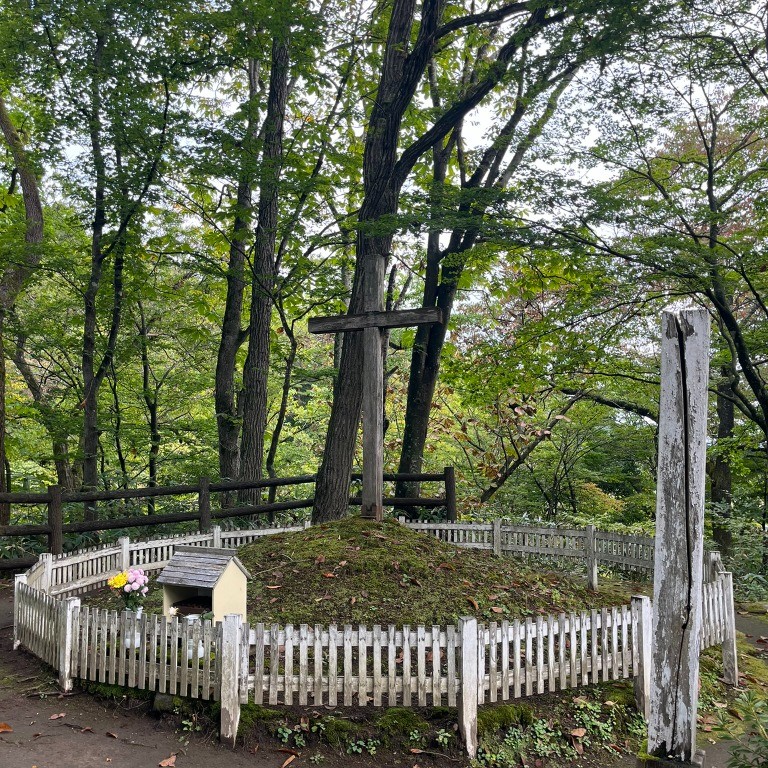
The Greatest Mystery in the Snowy Mountains
If you drive deep into the rural, mountainous region of Shingo Village, you will encounter one of the most baffling legends in Japan: The Tomb of Jesus Christ.
A local legend based on the controversial and apocryphal “Takenouchi Documents” tells a wildly different story from traditional theology. The legend claims that Jesus actually escaped the crucifixion, and his younger brother, “Isukiri,” took his place on the cross. Jesus fled across Siberia and Alaska, arriving by boat at Hachinohe, before settling in this secluded Aomori village.
A Peaceful Life in Rural Japan
The legend elaborates that Jesus changed his name to “Daitenku Taro Jurai,” married a local woman named Miyuko, and fathered three daughters. He supposedly lived a peaceful life as a garlic farmer and passed away naturally at the incredible age of 106.
Visitors can see two large dirt mounds topped with wooden crosses. One is said to be the burial site of Jesus, while the other contains the ear of his brother Isukiri. Every June, the local “Christ Festival” is held. Locals dress in traditional yukata and dance a Bon Odori around the crosses, singing a mysterious song called “Nanya Doyara,” which some argue is an ancient Hebrew chant.
📍 Specific Access Guide to The Tomb of Christ
By Rental Car: Public transportation to Shingo Village is extremely limited. The best and most highly recommended way to visit the Tomb of Christ is by Rental Car. You can rent a car directly at Hachinohe Station. The drive to Shingo Village takes about 40 to 50 minutes along beautiful countryside roads (Route 454). A large parking lot is available near the tomb and the adjoining museum.
// Matatabi Taro’s Travel Diary
Aomori Prefecture is a treasure trove of the bizarre, the sacred, and the beautiful. From dodging seagull “bombs” at Kabushima to contemplating the afterlife at Mount Osore, and solving the mystery of the Tomb of Christ, the deep north offers an unforgettable journey into the heart of Japanese spirituality. Rent a car, pack your bags, and get ready for an adventure you will never forget, meow!
A Note from OHA: The Real Aomori Experience
(A quick message from my human companion and photographer, OHA!)
“Aomori is an absolutely incredible place, but I was surprised by how few foreign tourists I encountered during my travels there. It truly feels like an untouched frontier!
The prefecture is also vastly wider than you might expect. When I rented a car and drove up the Shimokita Peninsula to visit Mt. Osore, it honestly felt like I was racing through endless, winding mountain passes for half a day just to reach the temple. And in the winter? The snow gets incredibly deep. I have nostalgic memories of the local trains completely stopping due to the heavy snowfall, forcing me to entirely change my travel itinerary on the fly! But that unpredictability and raw nature is exactly what makes Aomori such an unforgettable adventure.”