
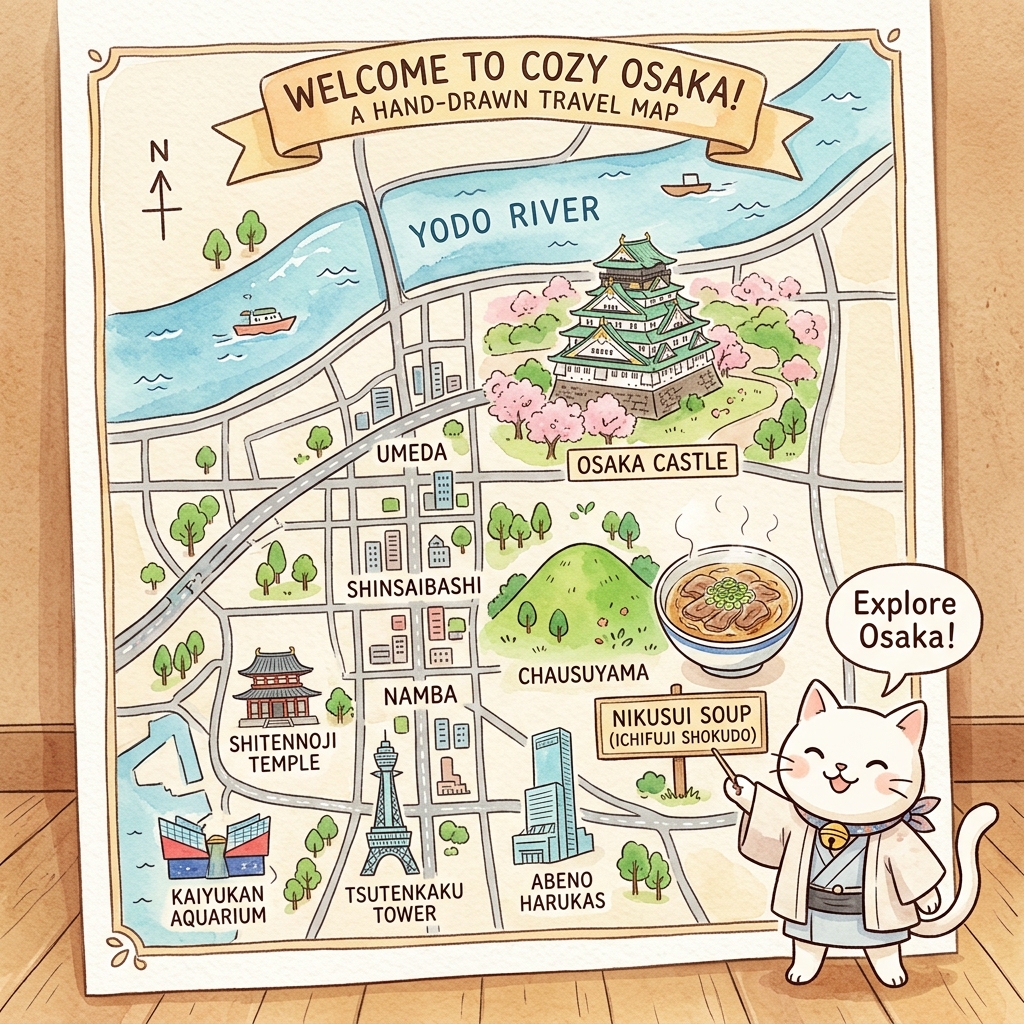
Osaka Castle is the absolute symbol of Osaka City, dominating the skyline with its massive stone walls, deep moats, and brilliant gold-leafed ornaments. But for many international tourists, taking a quick selfie in front of the main keep (Tenshukaku) is where the journey ends.
As your feline guide Matatabi Taro, I’m here to tell you that doing so means missing out on one of the most intense, blood-soaked, and fascinating histories in all of Japan. Guided by my human companion OHA, we dive deep beneath the concrete reconstructions to uncover the real Osaka Castle—a fortress built upon layers of fierce religious resistance, samurai glory, and devastating artillery fire.
The 4 Eras of Osaka Castle: A History of Destruction and Rebirth
To truly understand Osaka Castle, you must realize that the ground you are walking on has been repeatedly wiped out and built over. The castle’s history can be divided into four distinct and dramatic eras.
1. The Pre-Castle Era: Ishiyama Hongan-ji (1496–1580)
Long before any castle existed, this high ground was occupied by Ishiyama Hongan-ji, a heavily fortified temple complex belonging to a powerful sect of warrior monks. The geography here is crucial: bounded by the Yodo River to the north and the Yamato River to the south, the Uemachi Plateau was a natural, impenetrable fortress.
When the legendary warlord Oda Nobunaga attempted to unify Japan, these monks became his greatest obstacle. The resulting Ishiyama Hongan-ji War lasted an agonizing 10 years (the longest siege in Japanese history) before the monks finally surrendered and burned their own temple to the ground.
2. The Toyotomi Era: Hideyoshi’s Golden Glory (1583–1615)
Following Nobunaga’s death, the great unifier Toyotomi Hideyoshi claimed the charred remains of the plateau and began constructing the original Osaka Castle. Hideyoshi spared no expense, blanketing the castle in gold leaf to flaunt his absolute wealth and power.
However, after Hideyoshi’s death, the Tokugawa clan rose to power, leading to the dramatic Siege of Osaka (The Winter and Summer Campaigns of 1614-1615). Despite fierce resistance, the Toyotomi clan was entirely annihilated, and Hideyoshi’s magnificent golden castle was reduced to ash.
3. The Tokugawa Era: Burying the Past (1620–1868)
To establish absolute dominance and erase the memory of the Toyotomi clan, the Tokugawa Shogunate took a drastic step: they completely buried the ruins of Hideyoshi’s castle under massive amounts of soil. They then built a completely new, even larger Osaka Castle on top of it.
The gigantic stone walls you marvel at today? They are not Hideyoshi’s walls. They are the Tokugawa walls, built by ordering feudal lords from across Japan to transport immense megaliths (huge stones) to Osaka. Tragically, this Tokugawa castle also burned down following a lightning strike in 1665.
4. The Meiji Era to Present: The Concrete Guardian (1931–Present)
For centuries, the castle sat without a main keep. After the Meiji Restoration, the grounds were used as a military armory. It wasn’t until 1931 that the citizens of Osaka successfully crowdfunded the reconstruction of the Main Keep.
Because the structure needed to survive modern threats, it was built using steel-reinforced concrete. Miraculously, while massive American air raids during WWII destroyed the surrounding armories and burned much of the city, the concrete keep survived. During the post-war era, the castle even served a unique civic duty: the military fired a blank cannon shot every day at noon to tell time for the citizens of Osaka!
Architectural Marvels: Built to Withstand Anything
The Hybrid Tenshukaku (Main Keep)
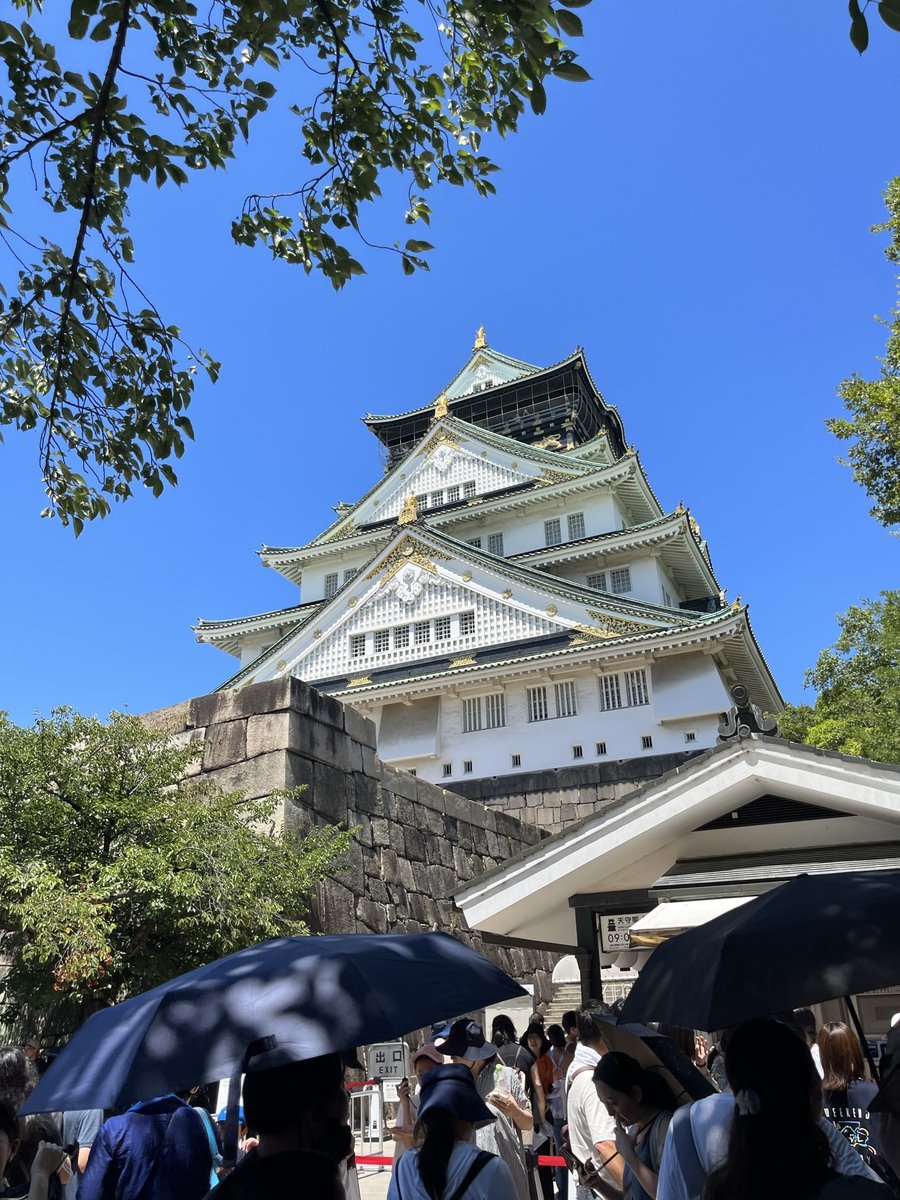
The current Main Keep is highly unique. It is a visual hybrid: the lower stories are designed to mimic the white-plastered Tokugawa style, while the top story features the black lacquer and golden tigers of Hideyoshi’s original vision. Today, the interior serves as a fantastic modern museum equipped with elevators, housing armor, weapons, and historical dioramas.
The Impregnable Moats and Stone Walls
The defining feature of Osaka Castle is its massive moats. The outer moats are incredibly wide, designed to keep enemy archers and matchlock guns out of range. The inner moats are dry in some sections and extremely deep. The sheer vertical drop of the stone walls (Ishigaki) is awe-inspiring. Notice the "Octopus Stone" near the Sakura Gate—it is an impossibly massive megalith weighing roughly 108 tons!
Surrounding Historical Sites: The Scars of the Siege
To truly appreciate the history, you must venture slightly outside the main park.
Sanadamaru: The Crimson Fortress
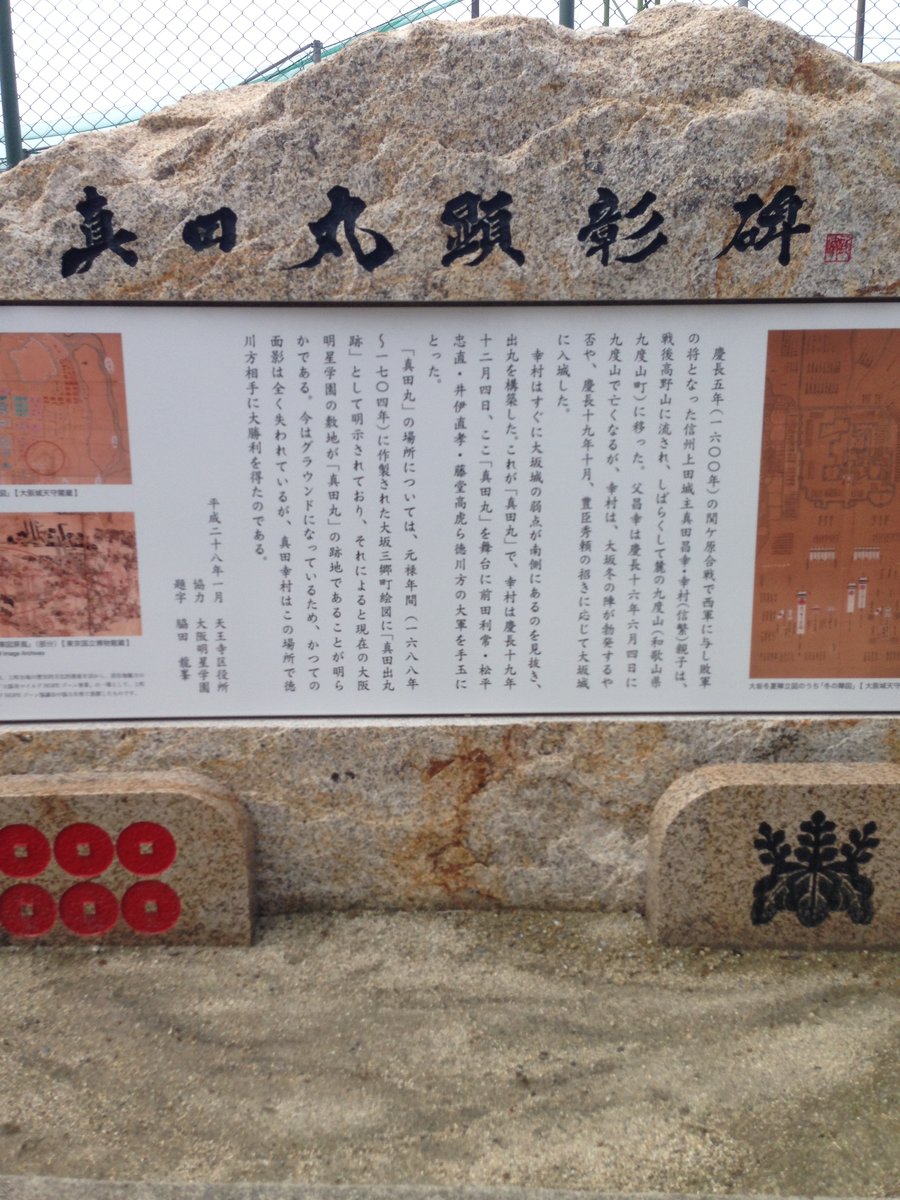
During the Winter Campaign of 1614, Tokugawa’s massive army laid siege to the castle. However, they found the southern approach heavily fortified by a brilliant tactical outpost known as Sanadamaru, commanded by the legendary warrior Sanada Yukimura. Here, Sanada’s forces inflicted devastating casualties on the Tokugawa army, famously repelling their advances. Today, a monument stands at the site of this legendary fortification.
The Culverin Cannons (Garubarin-ho)
Frustrated by the impenetrable walls and the Sanadamaru, Tokugawa Ieyasu resorted to psychological warfare. He procured massive British-made Culverin cannons and Dutch Saker cannons. These devastating weapons fired directly into the main keep where Hideyoshi’s widow, Yodo-dono, was residing. The sheer terror and destruction caused by this foreign artillery ultimately forced the Toyotomi to sue for peace—a decision that ultimately sealed their doom.
Chausuyama: Ieyasu’s Headquarters
Just a short distance away lies Chausuyama (within Tennoji Park). While long believed by locals to be an ancient keyhole-shaped burial mound, recent excavations have shown it to be a natural strategic hill. This elevated area served as Tokugawa Ieyasu’s main headquarters during the Winter Campaign of 1614. Ironically, it later served as Sanada Yukimura’s final command post during the tragic Summer Campaign of 1615. Standing on this hill offers a chilling perspective of how the warlords surveyed the battlefield before closing in on their enemies.
Local Gourmet: Recovering at Ichifuji Shokudo
Exploring Osaka Castle’s massive grounds is exhausting work. When hunger strikes, skip the tourist traps and head to where the locals eat.
Ichifuji Shokudo (一富士食堂)
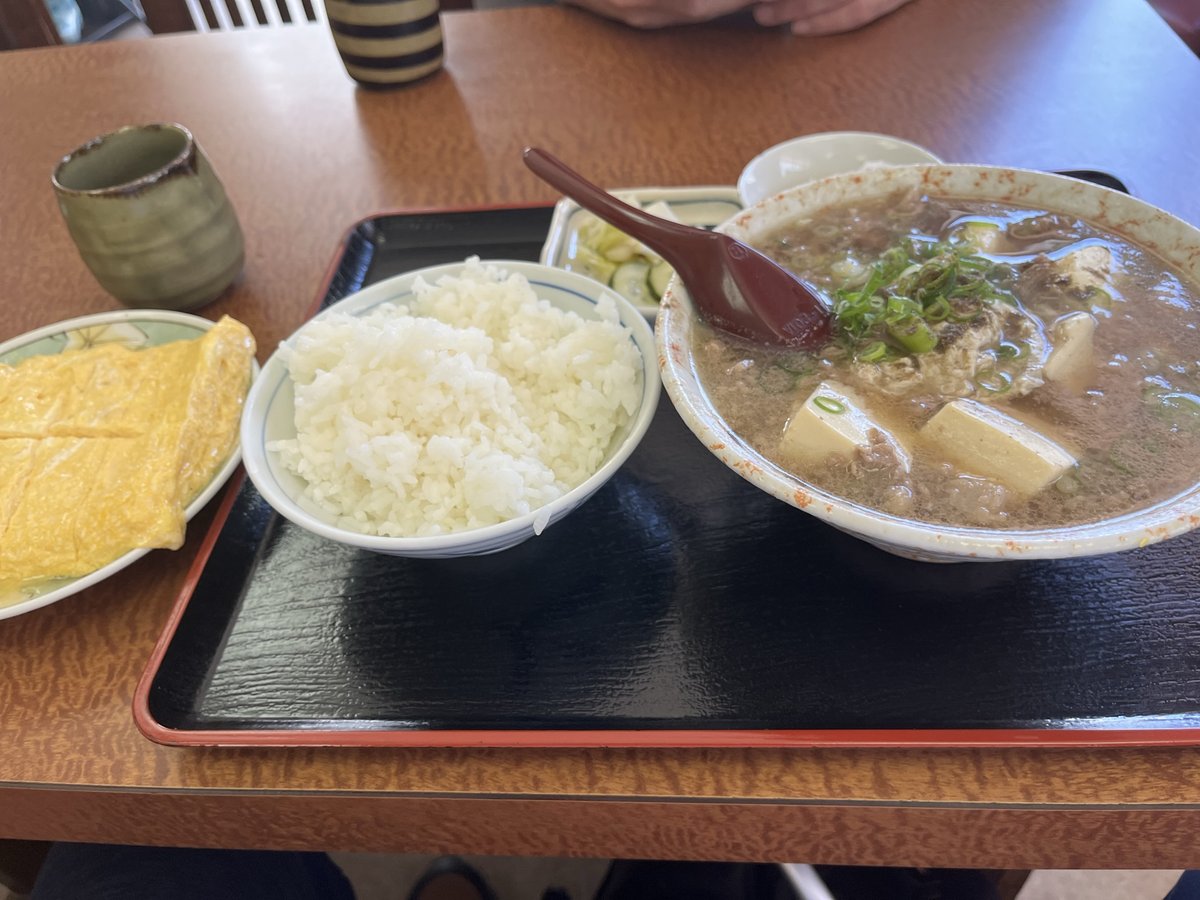
Located in the neighboring Minamimorimachi/Tenma area, Ichifuji Shokudo is an absolute institution of Osakan soul food. It is an old-school, unpretentious diner (Shokudo) that serves food meant to warm the soul.
- Nikusui (肉吸い): This is an iconic Osaka dish—essentially a rich, savory beef udon broth, but without the udon noodles! It is packed with tender beef and green onions, offering a deep umami hit.
- Dashimaki Tamago (だし巻き卵): Their traditional rolled omelet is incredibly fluffy and oozing with delicate dashi (savory broth). It is the ultimate comfort food after a long day of walking.
A Note from OHA: The Real Osaka Castle Experience
(A quick message from my human companion and photographer, OHA!)
"My very first encounter with Osaka Castle wasn’t from a history textbook—it was watching the classic tokusatsu series Ultraman, specifically the iconic scene where the ancient kaiju (monster) Gomora rampages through the streets of Osaka and absolutely destroys the castle keep.
In the story, Gomora had been sleeping peacefully underground for 10,000 years before being awakened by humans who wanted to transport it to a museum as a mere spectacle. During transport, it fell into Osaka and, naturally, wreaked havoc.
Right now, massive excavation projects are underway at Osaka Castle to dig up and investigate the buried stone walls of the original Toyotomi era, awakening a history that has slept underground for over 400 years. Looking at those deep trenches, I can’t help but wonder… what exactly will humanity awaken next?"
[Matatabi Taro’s Travel Tip]
Navigating Osaka requires a lot of walking and quick pit stops! Make sure you are prepared for your daily supply runs by checking out our Ultimate Convenience Store Survival Guide!