
Hello there, fellow travelers! I’m Matatabi Taro, your purr-fect guide and a curious traveling cat exploring every nook and cranny of Japan. As you wander through Japan, you’ll undoubtedly encounter stunning traditional buildings both in bustling cities and serene mountain retreats. A question I often get from my foreign friends is, “Taro, is that a temple or a shrine? How do I tell them apart?”
Did you know Japan is home to around 160,000 temples and shrines? That’s more than the number of convenience stores across the country! At first glance, they might seem similar, but they actually belong to entirely different religions with their own unique histories and customs. Today, I’m here to make it as simple as a cat’s meow to understand the differences between Japan’s Buddhist temples and Shinto shrines.
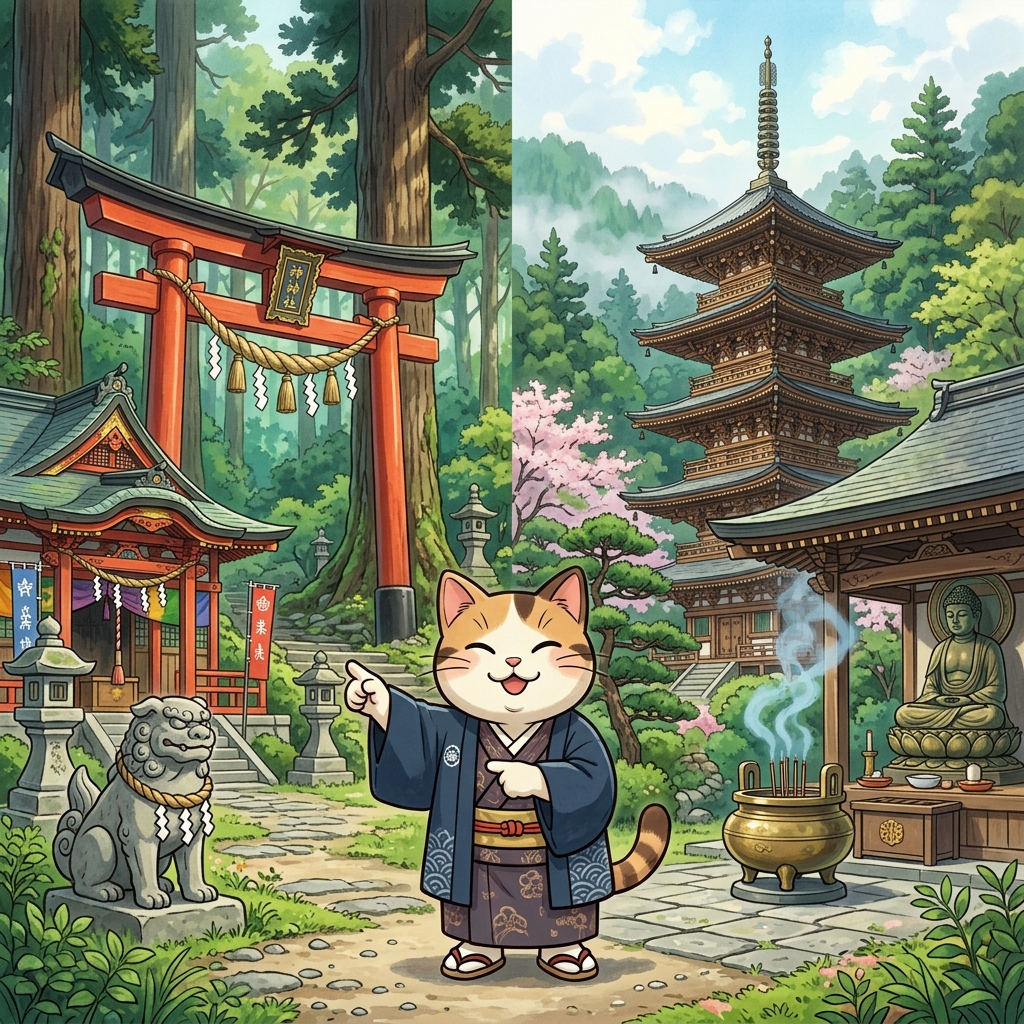
The Fundamental Differences: Shinto and Buddhism
Let’s start with the basics: the religion itself.
Shrines (Jinja) are dedicated to Shinto.
Shinto is Japan’s indigenous nature-based spirituality. It’s based on the belief of "Yaoyorozu no Kami" or "8 million gods," where kami (gods) reside in everything from mountains and rivers to winds and even people. Shinto has no definitive scriptures or founders and focuses on gratitude towards nature and prayers for bountiful harvests.
Temples (Tera) are dedicated to Buddhism.
Buddhism originated in India in the 5th century BCE and made its way to Japan around the 6th century via China and Korea. It centers on the teachings of Buddha, aiming for enlightenment and peace in the afterlife, known as the Pure Land.
Historical Context: Once Upon a Time, They Were Mixed!
For much of Japan’s history, Shinto and Buddhism were intertwined in a practice known as "Shinbutsu-shugo." It was common to find shrines within temple grounds and vice versa. However, during the Meiji Restoration in 1868, the government issued a decree to separate the two religions, known as "Shinbutsu-bunri." Today, they are managed as separate entities, but Japanese culture still flexibly embraces both—visiting shrines for New Year and temples for funerals.
Key Features to Identify Shrines
Spotting a shrine is simple if you know what to look for. The most distinctive feature is the "Torii gate" at the entrance. These gates, often red or made of stone, symbolize the boundary between the human world and the divine realm.
- Komainu: These lion-dog guardians are found at the entrance, protecting the shrine from evil spirits.
- Shimenawa: Thick straw ropes marking sacred spaces.
- Chozuya: A water ablution pavilion where visitors cleanse their hands and mouth before entering.
Key Features to Identify Temples
Temples do not have torii gates. Instead, they feature imposing "Sanmon gates" with grand roofs.
- Buddha Statues: The main hall of a temple houses statues of deities like Dainichi Nyorai or Kannon Bosatsu.
- Pagoda: A tall tower designed to enshrine Buddha’s relics.
- Jokoro: Large incense burners where visitors waft smoke over their bodies for health benefits.
Proper Etiquette When Visiting
Now that you can tell them apart, let’s talk about visiting etiquette, which can be quite the cat-challenge to remember!
Shrine Etiquette: “2 Bows, 2 Claps, 1 Bow”
- Toss a coin into the offering box.
- Ring the bell, if available, to greet the deity.
- Bow deeply twice.
- Clap your hands twice, then pray with your hands together.
- Bow deeply once more.
Temple Etiquette: “Silent Prayer”
- Toss a coin into the offering box.
- Gently ring any available bell.
- Do NOT clap your hands. Instead, pray silently with your hands together.
- Finish with a deep bow.
Pro tip from Taro: "Remember, clap at shrines, not at temples!" That’s all you need to know to impress!
Recommended Spots & How to Get There
Finally, here are must-visit spots that showcase each type beautifully.
Must-Visit Shrine: Fushimi Inari Taisha, Kyoto
Famous for its thousands of red torii gates, known as "Senbon Torii," this site offers an enchanting experience of Shinto’s mystical world. Inari, the deity of agriculture and business, is served by foxes, so you’ll see many fox statues around. The entire mountain is sacred, and you can hike all the way to the summit.
- Access (from Kyoto Station):
- Take the JR Nara Line from Kyoto Station (JR-A31) to Inari Station (JR-D03), just two stops and about 5 minutes away. The entrance is right in front of the station.
- Alternatively, from Fushimi Inari Station (KH34) on the Keihan Main Line, it’s about a 5-minute walk.
- Best Time to Visit: Early morning (around 7-8 AM) is highly recommended to dodge the crowds!
Must-Visit Temple: Sensō-ji, Tokyo
Pass through Kaminarimon with its giant red lantern, stroll down Nakamise Shopping Street, and you’ll find the magnificent main hall. Sensō-ji is like a lively Buddhist theme park with its smoky jokoro and omikuji (fortune-telling slips). It’s Tokyo’s oldest and most famous temple, dedicated to Kannon Bosatsu.
- Access (from Tokyo & Haneda Airport):
- From Tokyo Station: Take the JR Yamanote Line to Kanda Station, then transfer to the Tokyo Metro Ginza Line. Hop off at Asakusa Station (G-19), about 15 minutes total.
- From Haneda Airport (HND): Take the Keikyu Airport Line’s "Toei Asakusa Line Direct" train, which goes straight to Asakusa Station (A-18) without transfers, about 45 minutes. It’s a 5-minute walk to Kaminarimon.
- Must-Try Experience: Savor ningyoyaki (sweet bean cakes) or melon bread as you walk down Nakamise Street towards the main hall. It’s a pawsome way to enjoy your visit!
Next time you travel around Japan, check for torii gates or Buddha statues to identify where you are! With this knowledge, you’re well on your way to becoming a true Japan expert. Safe travels and have a meow-nificent adventure!
A Note from OHA: Respect and Spiritual Foundations
(A quick message from my human companion and photographer, OHA!)
“How did you enjoy learning about the religious culture of Japan?
No matter what country or region you travel to around the world, religious facilities are often some of the most prominent and beautiful tourist destinations. Japan is certainly no exception.
However, I trust that our wonderful readers will always remember one very important thing: these shrines and temples are not theme parks. They are deeply rooted spiritual sanctuaries and places of comfort for the local residents. I believe that you will explore these sacred grounds with the respect and reverence they deserve.”
[Matatabi Taro’s Travel Tip]
When visiting, just follow the simple etiquette we introduced in this guide, keep your voices down, and enjoy the peaceful atmosphere. Your respectful attitude is the best offering you can make, meow!